WindFlow
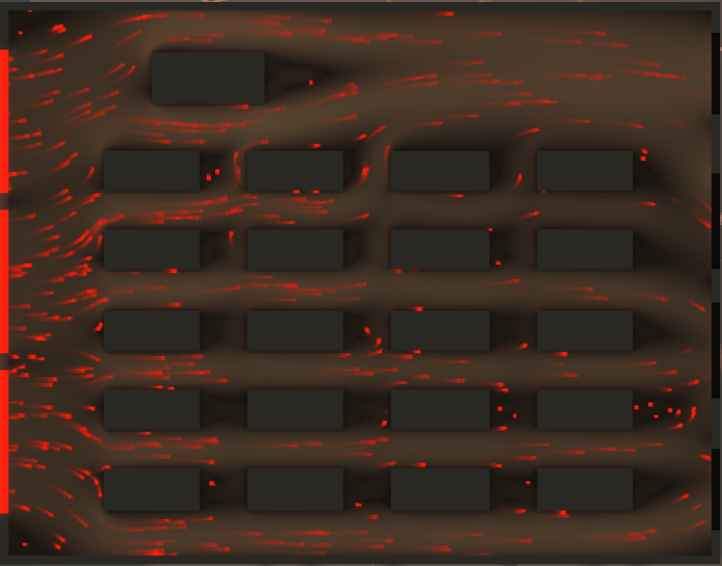
Real-time indoor airflow on the GPU: a D3Q19 lattice Boltzmann solver with LES, written in C#.
- Solver
- D3Q19 lattice Boltzmann, regularized BGK, Smagorinsky LES
- Particles
- Up to 1,000,000 on the GPU
- Throughput
- About 2,500 to 2,900 MLUPS on an RTX 5070 Ti
- CPU vs GPU
- Parity within 0.02%
- Orifice-equation check
- Cross-ventilation ratio 0.973
Problem
Architects decide where the openings go long before anyone simulates how air will move through the rooms. A CFD study is slow to set up, so it often comes too late.
I wanted to move a window and see the air respond.
Data and physics
The input is a building model with an outdoor margin around it. Openings can be toggled live, and fans, AC units, exhaust and diffusers are body-force regions.
Buoyancy runs on a coupled D3Q7 thermal lattice (Boussinesq, Guo forcing). A nested 2:1 fine simulation box is available for isothermal cases.
Method
The solver is D3Q19 lattice Boltzmann with a regularized BGK collision and Smagorinsky LES. One kernel serves both the CPU and the GPU, using ILGPU with CUDA, OpenCL or a CPU fallback.
Up to a million GPU particles with trails show the flow. Slices, probes and room metrics (air changes per hour, mean speed, stagnant fraction, age of air) sit alongside. The app exports a PDF report, a turntable MP4 and screenshots.
Result
WindFlow is in development: there is no public release and no public link yet. The analytic and self-consistency checks pass, including the orifice-equation check for cross-ventilation (ratio 0.973) and CPU/GPU parity (0.02%).
Validation against measured-room benchmarks is still in progress, so for now I treat the results as comparative rather than validated.
Built with: C# · .NET 10 · ILGPU · Avalonia · Direct3D 12